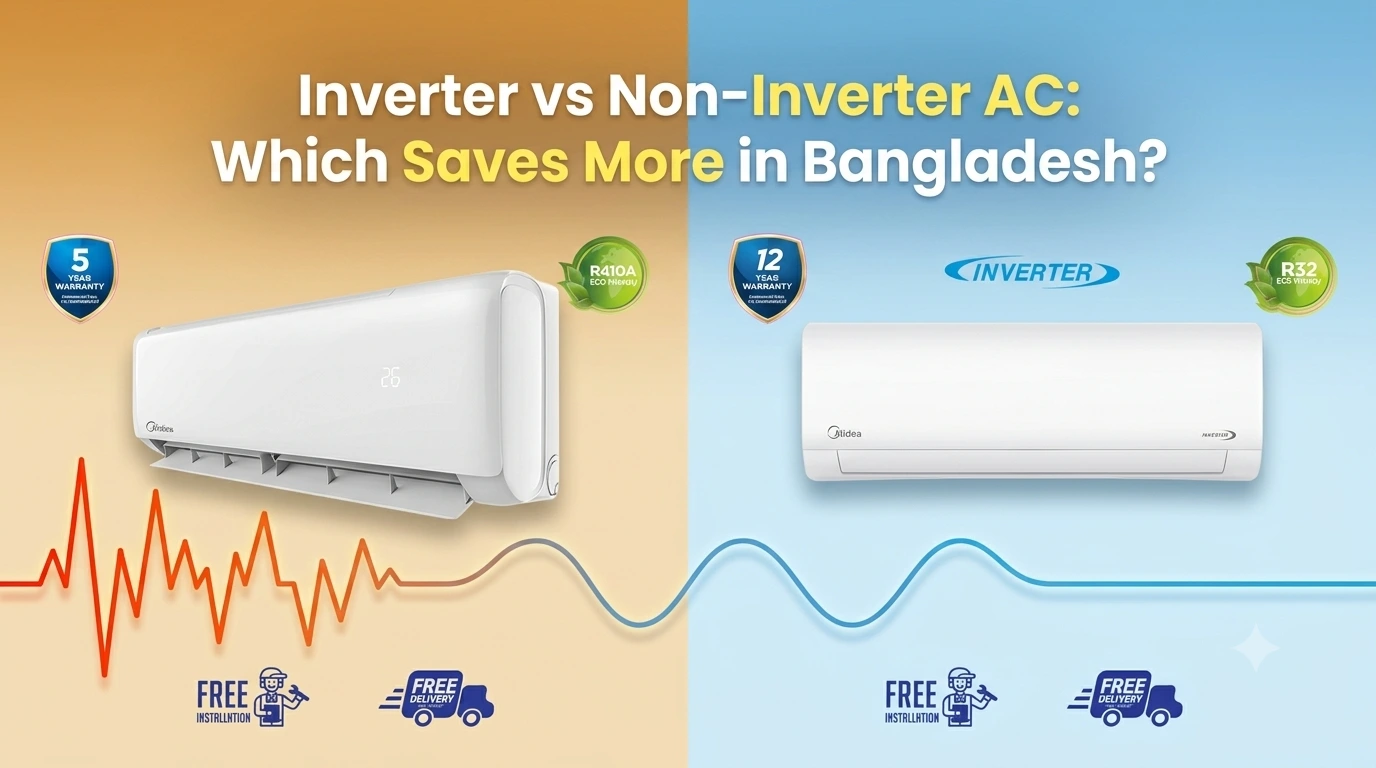
Every AC shop in Bangladesh will tell you the inverter is “better.” Fewer will tell you exactly why, and almost none will sit down and actually calculate whether the extra ৳15,000–20,000 upfront is worth it for your specific usage pattern. If you run the AC for two hours at night versus ten hours a day during a Dhaka heatwave, the answer to “inverter or non-inverter?” can be completely different.
This guide breaks down the real difference — not marketing language, actual numbers — so you can decide with confidence instead of just trusting whatever the salesman pushes that day.
What Is Inverter Technology?
An inverter AC uses a variable-speed compressor. Once your room reaches the set temperature, instead of switching off completely, the compressor slows down and runs at a lower speed to simply maintain that temperature. Think of it like a rickshaw-puller adjusting pedaling speed depending on the slope, rather than going full speed then stopping completely, over and over.
This means the compressor almost never has to do the energy-expensive job of “starting from zero” repeatedly — which is exactly where most of the electricity savings come from.
What Is Non-Inverter AC?
A non-inverter (also called “fixed speed”) AC runs its compressor at one constant speed — either fully on or fully off. Once the room hits the target temperature, the compressor shuts off entirely. When the room warms up a few degrees, it kicks back on at full power again. This on-off-on-off cycle is simpler mechanically, which is exactly why non-inverter units are cheaper to manufacture and buy.
How They Actually Work Differently
| Non-Inverter | Inverter | |
| Compressor speed | Fixed (100% or 0%) | Variable (adjusts automatically) |
| Temperature stability | Fluctuates a few degrees | Stays very close to set temperature |
| Startup frequency | Frequent on/off cycles | Starts once, then modulates |
| Mechanical complexity | Simple | More complex (built-in control board) |
| Manufacturing cost | Lower | Higher |
Electricity Bill Comparison — The Part Everyone Actually Cares About
Here’s the honest version most shops won’t walk you through: inverter ACs use roughly 30–40% less electricity than a non-inverter unit of the same capacity, but only once you’re running it for several hours continuously. The savings come from avoiding repeated full-power startups, which is the most electricity-hungry moment for any compressor.
Using approximate Bangladesh residential figures (actual numbers depend on your specific tariff slab and usage):
| Daily AC Usage | Non-Inverter 1.5 Ton (approx. monthly bill impact) | Inverter 1.5 Ton (approx. monthly bill impact) |
| 3–4 hours/day | Lower difference — savings are minimal | Slightly higher value, but payback is slow |
| 6–8 hours/day | Noticeably higher bill | Meaningfully lower bill — savings add up |
| 10+ hours/day (full-time office/shop) | Highest bill of the two | Largest absolute savings |
The pattern is simple: the more hours you run your AC daily, the more an inverter model pays for itself. If your AC mostly sits idle except for a couple of hours before bed, the gap is small enough that it may not be worth the extra purchase price.
Upfront Price Comparison
This is where the non-inverter wins outright. Looking at real pricing from Elite’s own lineup:
- Elite GOLD 1 Ton Non-Inverter (EHG12CRN) — around ৳39,000
- Elite GOLD 1.5 Ton Non-Inverter (EHG18CRN) — around ৳45,000
- Elite GOLD 2 Ton Non-Inverter (EHG24CRN) — around ৳55,000
Inverter models of the same capacity typically run ৳15,000–25,000 higher at purchase, depending on brand and series. That gap is real money — for a lot of Bangladeshi households, that’s most of a month’s salary, so it’s a completely valid reason to choose non-inverter if your usage hours are low.
Cooling Performance Difference
Inverter ACs cool more evenly. Because the compressor modulates instead of switching off completely, the room temperature stays within a narrower band — you won’t feel that slight warm-up before the compressor kicks back on, which is common with non-inverter units. For a baby’s room, a home office where you’re working long hours, or anyone particularly sensitive to temperature swings, this matters more than the electricity bill itself.
Non-inverter ACs still cool effectively — they just do it in a more “stop-start” rhythm. For most bedrooms and living rooms used a few hours a day, this difference is barely noticeable in daily life.
Noise Level Comparison
Inverter compressors generally run quieter overall, since they spend most of their time at partial (lower) speed rather than cycling between off and full blast. Non-inverter units tend to have a more noticeable “thunk” and hum each time the compressor restarts at full power. If your bedroom is small and the AC is close to your bed, this is worth factoring in — especially for light sleepers.
Durability & Maintenance
Non-inverter compressors are mechanically simpler, which historically meant fewer electronic parts to fail — a real advantage in Bangladesh where voltage fluctuation is common. However, modern inverter units sold by major distributors (including Midea’s range) now include surge protection and voltage stabilization built into the control board, narrowing this gap significantly. Maintenance requirements — filter cleaning, annual gas check — are essentially identical for both types.
Which Is Better for Bangladesh’s Climate?
Honestly, both work fine in Bangladesh’s heat and humidity — climate alone isn’t the deciding factor. What matters more is how many hours per day you actually run the unit, and how sensitive your budget is to the upfront price difference. A few practical patterns we see across Bangladeshi households:
- Bedrooms used mainly at night (6–8 hours) → Inverter tends to make more financial sense over 2–3 years
- Living rooms used occasionally (2–4 hours) → Non-inverter is usually the more practical choice
- Shops, offices, restaurants running AC most of the day → Inverter almost always wins on total cost of ownership
- Tight upfront budget, AC is “nice to have” not constant → Non-inverter, no contest
Inverter AC Models — Elite & Midea
If you’ve decided inverter fits your usage pattern, here’s where to look:
- Elite Inverter Series — Elite’s own cooling-only inverter models, including 1 Ton, 1.5 Ton, and 2 Ton options manufactured in Cumilla
- Midea Inverter Cooling Series — wall-mounted inverter units with strong energy ratings
- Midea 1.5 Ton Cooling Only Inverter AC — one of the most searched inverter models in Bangladesh right now
Non-Inverter AC Models — Elite & Midea
If your usage pattern points toward non-inverter, these are solid, budget-friendly picks:
- Elite GOLD Series — non-inverter split units from 1 Ton to 2 Ton, starting around ৳39,000
- Midea Non-Inverter On-Off Series — reliable fixed-speed cooling at a lower entry price
- Midea 1 Ton Wall Type AC — a popular non-inverter pick for smaller rooms
When Should You Choose an Inverter?
- You run your AC 6+ hours a day, every day, especially through peak summer
- You want the most stable, even room temperature (good for babies, the elderly, or home offices)
- You can comfortably afford the higher upfront price and want to save on bills long-term
- Noise level matters to you, especially for bedrooms
When Should You Choose Non-Inverter?
- You only run AC occasionally — a few hours a night, or only during the hottest weeks of summer
- Your upfront budget is the primary constraint right now
- You’re buying for a guest room, occasional-use space, or a rental property where minimizing cost matters more than long-term efficiency
- You want the simplest, most field-serviceable option with widely available parts
Break-Even Analysis — When Does Inverter Actually Pay for Itself?
Let’s walk through a simplified, illustrative example (your actual numbers will vary based on your specific tariff slab and exact usage):
Say a 1.5 Ton non-inverter unit costs ৳45,000 and a comparable 1.5 Ton inverter unit costs ৳62,000 — a ৳17,000 difference. If running the AC for around 8 hours a day saves you a meaningful chunk on your monthly bill thanks to the inverter’s efficiency, that gap typically closes somewhere in the 2nd to 3rd year of ownership, depending on how consistently you use it through both summer and winter months.
If you’re running the AC for only 3 hours a day, that same ৳17,000 gap may never fully close within the unit’s typical lifespan — which is exactly why “inverter is always better” isn’t quite true. It’s better if you use it enough to let the efficiency gains do their work.
Practical rule of thumb: if you genuinely use your AC daily through most of the year (not just 3-4 months), an inverter is very likely worth it. If your usage is occasional or seasonal only, non-inverter remains a perfectly smart, budget-conscious choice — there’s no shame in choosing it, despite what some sales pitches imply.
Understanding Energy Star Ratings (What the BSTI Label Actually Tells You)
Most ACs sold in Bangladesh carry an energy efficiency star rating, typically from 1 to 5 stars under the local BSTI labeling system. A higher star rating means the unit consumes less electricity to deliver the same cooling output — but here’s what often gets confused: star rating and inverter technology are not the same thing.
You can find a 5-star non-inverter AC and a 3-star inverter AC. The star rating tells you about efficiency within that specific model’s design, while inverter vs non-inverter tells you about the type of compressor technology. For the best possible efficiency, look for both — a high star rating AND inverter compressor together. But if you’re choosing on budget, a well-rated non-inverter unit can still outperform a poorly-rated inverter one in real-world bills.
When comparing two units side by side at a showroom, always ask for the star rating sticker specifically — don’t assume “inverter” alone means maximum efficiency.
Real Scenarios from Bangladeshi Households
To make this more concrete, here’s how the decision typically plays out across common situations we see:
Scenario 1: Newlywed couple, one bedroom, Dhaka apartment AC runs roughly 6-7 hours nightly through summer, less in winter months. With consistent multi-month usage, an inverter unit’s savings noticeably offset the higher purchase price within a couple of years — a reasonable case for choosing an inverter if the budget allows the higher upfront cost.
Scenario 2: Family living room, used only during family time in the evening Maybe 2-3 hours a day, mostly during hot months. Here, a non-inverter Elite GOLD unit makes more practical sense — the electricity savings from an inverter wouldn’t meaningfully offset the extra purchase price within a reasonable ownership period.
Scenario 3: Small business owner, shop AC running during business hours 8-10 hours a day, 6 days a week, almost year-round. This is the clearest case for inverters — the daily runtime is high enough that efficiency gains compound quickly, often justifying the higher upfront investment within the first year or two of commercial operation.
Scenario 4: Guest room, used only when relatives visit Maybe 10-15 days a year of actual use. Non-inverter is the obvious choice here — there’s no realistic usage volume to ever recover an inverter price premium.
These scenarios aren’t exhaustive, but they illustrate the core principle running through this entire guide: usage hours, not climate or brand preference, should drive your decision.
Frequently Asked Questions
Does inverter AC really save electricity in Bangladesh’s heat?
Yes, but the savings scale with usage hours. Running it most of the day shows clear savings; running it occasionally shows minimal difference.
Is non-inverter AC outdated or bad?
No. It’s a completely valid, reliable choice for lower-budget buyers or occasional use — it’s simply less efficient for heavy daily use, not inferior in build quality.
Which type handles Bangladesh’s voltage fluctuation better?
Both can handle it well if paired with a proper voltage stabilizer. Non-inverter’s simpler mechanics historically had an edge, but modern inverter units from established distributors now include built-in protection.
Can I switch from non-inverter to inverter later, or should I decide now?
Each unit is a separate purchase and installation — there’s no “upgrade path” on the same unit. It’s worth deciding based on realistic usage now rather than assuming you’ll switch later.
Final Verdict
There’s no universal “winner” here — only the right choice for your specific usage. If you want a one-line takeaway: count your actual daily AC hours honestly, and let that number decide. Heavy daily users save real money with inverters over a few years. Occasional users are better off keeping that extra ৳15,000–20,000 in their pocket and choosing non-inverter.
Still unsure which capacity you need before comparing inverter vs non-inverter pricing? Check our BTU calculator guide first, then come back to this comparison once you know your exact ton requirement.