If you’re setting up a new shop in Dhaka’s New Market, fitting out a small garments office in Gulshan, or renovating a restaurant floor in Chittagong, the AC decision isn’t just “which brand” anymore — it’s “which type.” A wall-mounted split unit that’s perfect for a bedroom looks completely out of place (and often performs worse) in a 600 sq ft retail showroom. This guide walks through the four main commercial AC types available in Bangladesh, so you pick the right one the first time instead of redoing your ceiling work in six months.
Types of Commercial Air Conditioning in Bangladesh
There are four common installation types you’ll come across when shopping for office or shop AC:
- Split Type — the familiar wall-mounted unit, scaled up to commercial capacities
- Cassette Type — mounted flush into the ceiling, cooling spreads in all directions
- Duct Type — fully hidden inside a false ceiling, air delivered through ducting and grilles
- Floor Standing — a tall freestanding unit, often used where ceiling installation isn’t practical
Each one suits a different kind of space, budget, and aesthetic — let’s go through them one by one.
Split Type AC — Features & Benefits
The split type is simply a residential-style wall-mounted unit scaled up to higher capacities (2 ton, 2.5 ton, and beyond). It’s the cheapest commercial option to install since it doesn’t require any ceiling work — just a wall bracket and standard piping.
Best for: Small office cabins, single-room shops, or businesses retrofitting an existing space without budget for ceiling modification.
Limitation: At higher capacities, wall-mounted units can look bulky and the airflow pattern is more directional — meaning parts of a larger room may cool less evenly than with a ceiling-distributed system.
Cassette Type AC — Features & Benefits
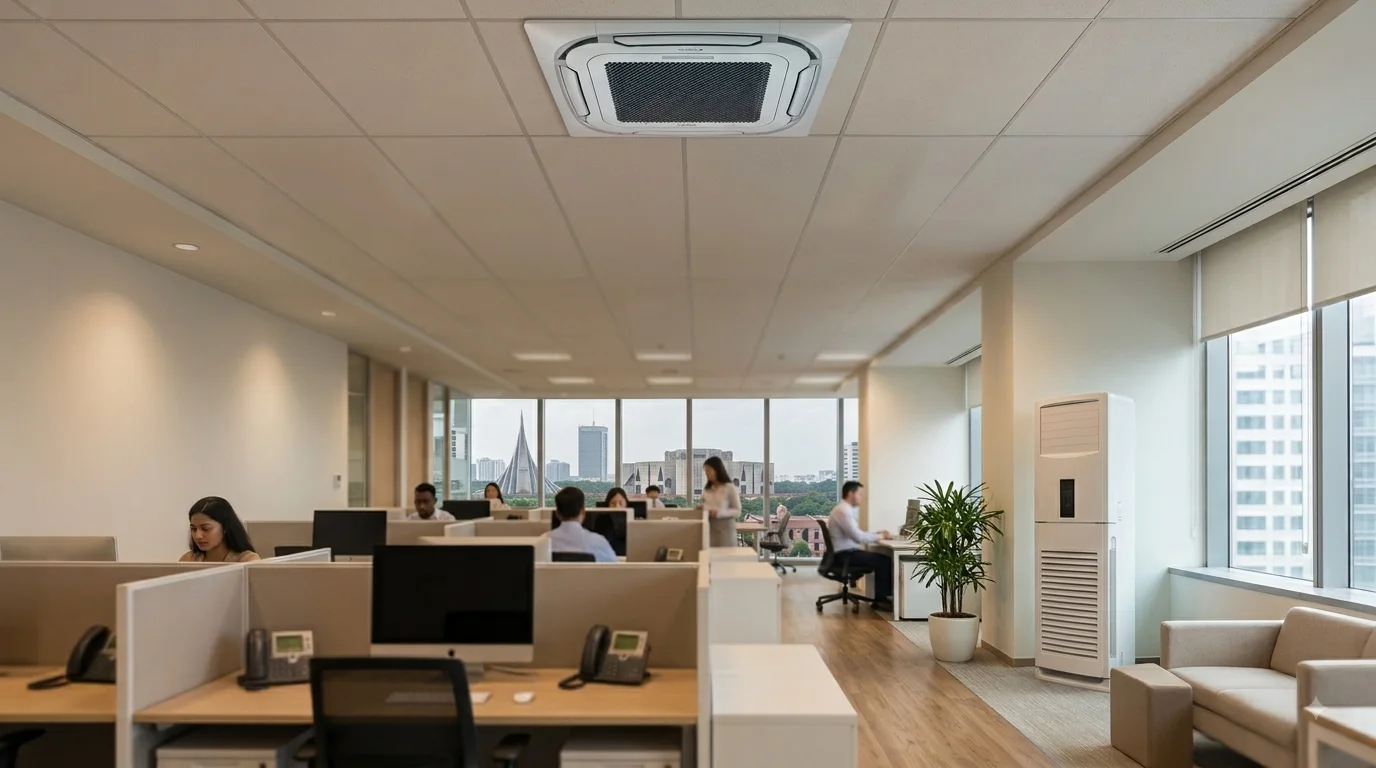
A cassette AC sits flush inside a false/suspended ceiling, with only a slim panel visible from below. Cool air is distributed in all four directions simultaneously, making it one of the most even-cooling options available for medium-to-large commercial spaces.
Best for: Retail showrooms, restaurant dining areas, open-plan offices, and any space where you want the AC to disappear visually into the ceiling rather than stand out on a wall.
This is also one of the most under-served search categories in Bangladesh right now — the query “cassette type ac” alone generates massive search interest, yet very few sites rank well for it with genuinely useful content. If you’re a business owner researching this type, you’re in good company; a lot of people are searching for exactly this comparison.
Duct Type AC — Features & Benefits
A duct type AC is installed entirely above a false ceiling, completely out of sight, with only small linear or square grilles visible in the ceiling. Air is distributed through a network of ducting, allowing one unit to cool multiple zones or rooms from a single concealed system.
Best for: Larger offices needing zone control (different temperatures for different areas), spaces where you want zero visible equipment, and buildings with a properly designed false ceiling already in place.
Limitation: Requires the most upfront ceiling and ducting work, making it the most installation-intensive option — best planned during initial fit-out rather than retrofitted later.
Floor Standing AC — Features & Benefits
A floor standing unit sits directly on the ground (or a small platform) and looks similar to a tall cabinet. No ceiling work is needed at all — it simply needs floor space and a nearby outdoor unit connection.
Best for: Spaces with low or irregular ceilings, temporary shop setups, warehouses, factory floors, or any location where ceiling-mounted installation isn’t practical or where the tenant doesn’t want to make structural changes to a rented space.
Limitation: Takes up usable floor space — a real consideration in smaller Dhaka retail units where every square foot of display or seating area matters.
Space Requirements & Installation Comparison
| Type | Ceiling Work Needed | Floor Space Used | Installation Complexity |
| Split | None | None | Low |
| Cassette | Yes (false ceiling) | None | Medium |
| Duct | Yes (extensive) | None | High |
| Floor Standing | None | Yes | Low |
If you’re renting your commercial space and can’t modify the ceiling (a very common situation for shop tenants in Bangladesh), split or floor standing are your realistic options. If you own the building or have a long-term lease with renovation rights, cassette or duct open up better cooling distribution.
Aesthetics & Design Considerations
For customer-facing businesses — retail shops, restaurants, salons — how the AC looks matters more than people initially think. A bulky wall unit can clash with interior design, while a cassette type blends invisibly into a finished ceiling, giving a cleaner, more premium feel to the space. If you’re investing in shop interior design, it’s worth budgeting cassette or duct type into that same renovation phase rather than treating AC as an afterthought.
Floor standing units, while practical, are the most visually prominent — something to factor in if your space has limited room to “hide” a tall unit out of customer sightlines.
Cooling Efficiency Comparison
Cassette and duct types generally deliver the most even cooling across a room, since air is distributed from the ceiling across multiple directions or zones. Split and floor standing units tend to create more of a directional cooling pattern — effective, but you may notice warmer spots further from the unit in larger rooms.
For a single small office cabin (under 200 sq ft), this difference is negligible. For an open retail floor or restaurant dining area (400+ sq ft), the even distribution from a cassette or duct system becomes much more noticeable to customers and staff alike.
Maintenance & Service Access
| Type | Filter/Service Access | Typical Maintenance Effort |
| Split | Easy — front panel access | Low |
| Cassette | Moderate — ceiling panel removal | Medium |
| Duct | Harder — requires accessing ducting | Medium-High |
| Floor Standing | Easy — front/side panel access | Low |
This is worth discussing with your installer upfront: duct systems in particular need a properly planned access point built into the false ceiling design, or routine filter cleaning becomes a bigger job than it should be.
Cost Comparison (Purchase + Installation)
Pricing varies by capacity and brand, but here’s a general sense of where things stand using real Midea pricing as a benchmark:
- Midea 2 Ton Duct Type (MHC24CR) — around ৳1,26,600
- Midea 2 Ton Floor Standing (MGFA24CR) — around ৳1,10,000
- Midea 3 Ton Floor Standing (MGFA36CR) — around ৳1,70,000
- Midea 4 Ton Floor Standing (MGFA48CR) — around ৳2,10,800
- Midea 5 Ton Floor Standing (MFGA60CR) — around ৳2,25,000
Cassette and ceiling type units in comparable capacities generally sit in a similar pricing band to duct type, with installation cost varying based on how much false ceiling work is already in place. For an exact quote on cassette or ceiling units for your specific space, it’s worth contacting the showroom directly with your room dimensions — pricing depends heavily on ducting/ceiling condition at your site.
As a rule of thumb across all four types: split is cheapest to install, duct is most expensive to install, with cassette and floor standing sitting in between — though floor standing wins on installation simplicity despite using more visible space.
Operating Noise Levels
Floor standing units tend to be the noisiest of the four, since the compressor-adjacent components sit closer to occupied space. Cassette and duct types are generally quietest from the occupant’s perspective, since most of the mechanical noise is contained within the ceiling void. Split type sits in the middle — quiet enough for most office use, but noticeable in a fully silent space like a small meeting room.
For noise-sensitive environments — meeting rooms, private clinics, recording studios — cassette or duct type is almost always the better choice.
Which Type for Different Office/Shop Sizes?
| Space Type | Recommended AC Type |
| Small office cabin (under 150 sq ft) | Split |
| Retail shop, 150–400 sq ft | Cassette |
| Restaurant dining floor, 400+ sq ft | Cassette or Duct |
| Open-plan office with multiple zones | Duct |
| Warehouse / factory floor | Floor Standing |
| Rented space, no ceiling modification allowed | Split or Floor Standing |
Elite Commercial AC by Type
Elite’s locally manufactured commercial range covers most of these categories directly:
- Elite Cassette Series — including inverter cassette models from 1.5 to 5 ton
- Elite Duct Type AC — 2.5 to 5 ton options
- Elite Floor Standing AC — 3, 4, and 5 ton models
- Full Elite Commercial Range
Midea Commercial AC by Type
Midea’s range, distributed exclusively by Elite, covers the full spectrum with international engineering:
- Midea Cassette Type AC — both inverter and non-inverter, 1.5 to 5 ton
- Midea Floor Standing AC — 2 to 5 ton
- Midea Duct Type AC — 2 to 5 ton
- Midea Ceiling Type AC — 3 to 5 ton
Installation Considerations Before You Commit
A few practical questions worth asking your installer or the AC showroom before finalizing your choice:
- Is there already a false ceiling, or will one need to be built? This single factor often decides between split/floor standing versus cassette/duct.
- Will you be moving locations within 2–3 years? If this is a short-term lease, split or floor standing avoids leaving expensive ducting behind for the next tenant.
- What’s your power supply situation? Higher-capacity commercial units (4 ton+) need a dedicated circuit — confirm this is in place before installation day, not after the unit arrives.
- Who handles warranty and service if something breaks? Since Elite is both the Elite manufacturer and Midea’s Master Distributor, you get one service network regardless of which type or brand you choose — worth confirming this with any other supplier you’re comparing against.
Long-Term Ownership Costs
Beyond the purchase price, think about total cost over a 5-year horizon:
- Split & Floor Standing: Lowest installation cost, but may need supplementary units if the space grows or layout changes
- Cassette: Mid-range installation cost, excellent even cooling reduces strain on the compressor over time
- Duct: Highest installation cost, but a single system can serve multiple zones — potentially cheaper than buying multiple separate units for a large open space
For a growing business — a shop that might expand, an office adding staff — it’s worth thinking one step ahead rather than optimizing purely for today’s square footage.
Frequently Asked Questions
Can I install a cassette AC without a false ceiling?
No — cassette units require a suspended/false ceiling to recess into. If your space doesn’t have one, either budget for ceiling construction or consider split or floor standing instead.
Which commercial AC type is cheapest overall?
Split type has the lowest combined purchase + installation cost, since no ceiling work is required. Floor standing is similarly low-installation-cost but uses more visible floor space.
Is duct type AC worth it for a small shop?
Usually not — duct systems make the most financial sense for larger spaces with multiple zones. For a single-room shop, cassette or split typically offers better value.
Do commercial AC units need different maintenance than home AC?
The core maintenance (filter cleaning, annual gas check) is similar, but commercial units run more hours per day on average, so servicing intervals should generally be more frequent — every 4-6 months rather than once a year.
Final Verdict
If you’re renting and can’t touch the ceiling — split or floor standing. If you own the space or are doing a full interior fit-out and want the cleanest look with the best even cooling — cassette. If you’re cooling a large, multi-zone commercial floor and want everything hidden — duct. There’s no universally “best” type here, only the type that matches your space, your lease situation, and how the business will use that room day to day.
Not sure which capacity (ton) you need for your specific square footage yet? Check our BTU calculator guide first — the sizing principles apply to commercial spaces too, just scaled up. And if you’re still deciding between inverter and non-inverter for a commercial unit running long hours daily, our inverter vs non-inverter comparison is especially relevant for business use cases.