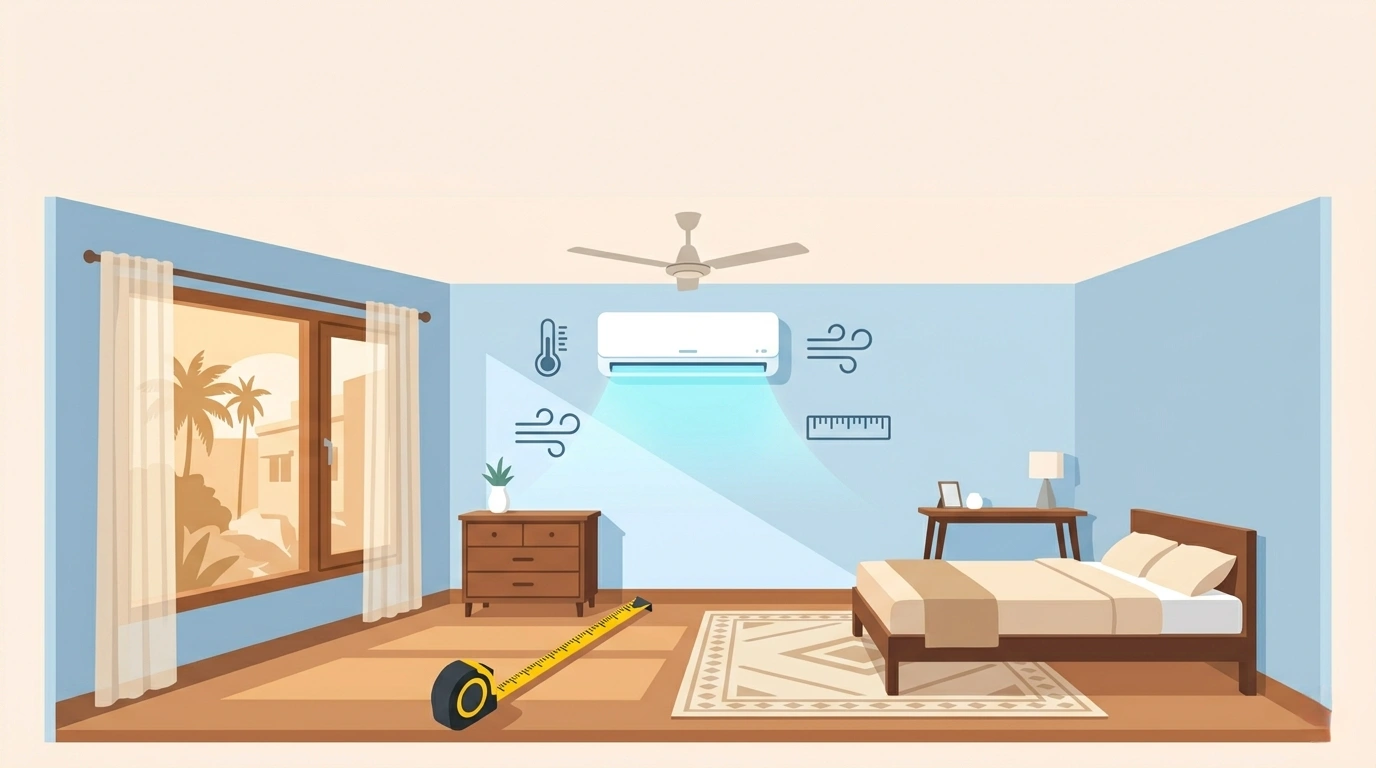
“Bhai, amar room-er jonno koto ton AC lagbe?” — this is probably the single most common question asked at every AC shop counter in Bangladesh. And honestly, most shopkeepers answer it with a quick guess based on room size alone, without asking about ceiling height, sunlight, or how many people actually use the room. That guess is exactly why so many households end up with an AC that either can’t cool the room properly or costs way more on the electricity bill than it should.
This guide walks you through exactly how to calculate the right ton size for your space — no engineering degree required, just a tape measure and five minutes.
Understanding AC Ton & BTU — The Basics
Every air conditioner’s cooling power is measured in BTU (British Thermal Units) per hour. “Ton” is just a simpler way of expressing that same number — 1 Ton equals 12,000 BTU/hr. So when someone says “1.5 ton AC,” they really mean an AC rated at 18,000 BTU/hr.
Here’s the conversion you’ll see most often in Bangladesh:
| Ton | BTU/hr |
| 1 Ton | 12,000 BTU |
| 1.5 Ton | 18,000 BTU |
| 2 Ton | 24,000 BTU |
| 2.5 Ton | 30,000 BTU |
| 3 Ton | 36,000 BTU |
| 4 Ton | 48,000 BTU |
| 5 Ton | 60,000 BTU |
The bigger the BTU rating, the more heat the AC can remove from a room per hour — which means a bigger room (or a room with more heat sources) needs a higher BTU/ton rating to cool effectively.
Room Size to AC Capacity Chart (Bangladesh Context)
This chart is based on standard residential conditions in Bangladesh — a room with normal ceiling height (around 9–10 feet), average sunlight exposure, and 2–3 people using the space:
| Room Size (sq ft) | Recommended Capacity |
| Up to 120 sq ft | 1 Ton (12,000 BTU) |
| 120–180 sq ft | 1.5 Ton (18,000 BTU) |
| 180–250 sq ft | 2 Ton (24,000 BTU) |
| 250–320 sq ft | 2.5 Ton (30,000 BTU) |
| 320–400 sq ft | 3 Ton (36,000 BTU) |
| 400–550 sq ft | 4 Ton (48,000 BTU) |
| 550–700 sq ft | 5 Ton (60,000 BTU) |
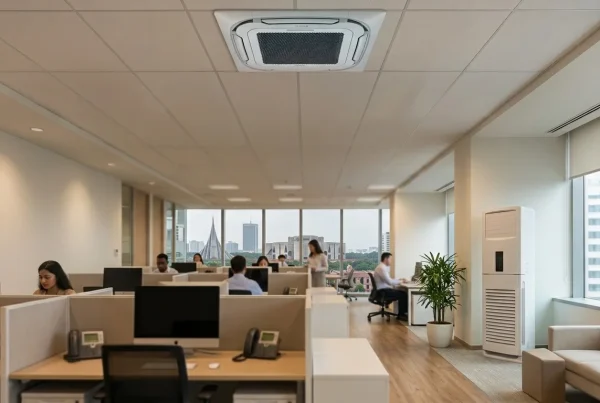
| 700 sq ft+ / shop floor / restaurant | Commercial type (cassette, duct, or floor standing) |
To calculate your room size quickly: multiply the length and width of the room in feet. A 12 ft × 12 ft bedroom is 144 sq ft — comfortably in 1.5 Ton territory.
Factors That Actually Change Your Calculation
The chart above is a solid starting point, but several real-world factors can push you up or down a size category:
Direct sunlight exposure A south or west-facing room that gets direct afternoon sun needs roughly 10–15% more cooling capacity than a shaded room of the same size. If your bedroom window faces the afternoon sun, consider going up half a ton from the chart recommendation.
Number of people in the room Each additional person generates body heat that the AC has to work against. A standard calculation assumes 2 people; for a family room or shared office space with 4–5 people regularly, add roughly 600 BTU per extra person.
Ceiling height Most flats in Dhaka have standard 9–10 foot ceilings, which the chart already accounts for. But if you’re cooling a duplex living room or a space with a higher ceiling (common in some older buildings), you’ll need extra capacity since there’s more air volume to cool.
Kitchen-adjacent rooms or heat-generating equipment A bedroom next to the kitchen, or an office with multiple computers/servers running, generates extra ambient heat. Factor in 10% extra capacity in these situations.
Number of windows and doors More glass surfaces and gaps mean more heat entering the room. A room with large windows or a balcony door may need slightly more cooling than a fully enclosed room of the same square footage.
1 Ton AC — Best For What Room Size?
A 1 Ton AC is ideal for small bedrooms, single-person home offices, or study rooms up to around 120 sq ft. This is the most searched AC size in Bangladesh for a reason — it fits the typical “second bedroom” or “kids’ room” setup in most flats. Budget-friendly and sufficient for moderate Dhaka heat if the room isn’t facing direct afternoon sun.
1.5 Ton AC — Best For What Room Size?
The 1.5 Ton AC is, without question, the most popular size sold in Bangladesh — and the data backs this up clearly, since “1.5 ton ac price in bangladesh” consistently ranks among the highest-searched AC queries nationwide. It comfortably cools master bedrooms and standard living rooms between 120–180 sq ft, making it the safe default choice for most middle-class households.
2 Ton AC — Best For What Room Size?
A 2 Ton AC suits larger living rooms, open-plan dining-cum-living spaces, or bedrooms with heavy sunlight exposure between 180–250 sq ft. This is also a common choice for small home offices or shop fronts that need slightly stronger cooling than a standard bedroom.
2.5 Ton and Above — Commercial-Leaning Use Cases
Once you cross into 2.5–3 ton territory, you’re usually looking at larger living areas, small retail shops, or office cabins. From 4 ton upward, most buyers move toward duct type or cassette type installations rather than standard wall-mounted split units, since these are built for sustained commercial-grade cooling across larger floor areas.
Common Mistakes in Choosing AC Size
Mistake 1: Rounding down to save money Some buyers deliberately choose a smaller ton than recommended to save on the upfront purchase price. This almost always backfires — an undersized AC runs constantly at full power trying to reach the set temperature, which increases your electricity bill and shortens the compressor’s lifespan faster than buying the correctly sized unit would have cost you.
Mistake 2: Rounding up “just to be safe” The opposite mistake is equally common — buying a bigger ton “to be sure it cools well.” An oversized AC cools the room too quickly, shuts off, then turns back on repeatedly (called short-cycling). This creates an uneven temperature, more humidity in the room (since the AC doesn’t run long enough to properly dehumidify), and unnecessary extra cost on both the unit and your bill.
Mistake 3: Ignoring the room’s specific conditions Two bedrooms of the exact same square footage can have completely different cooling needs if one faces direct sun and the other doesn’t. Always factor in your room’s real conditions, not just the raw measurement.
Over-Sizing vs Under-Sizing — Why Both Are Costly
| Under-sized AC | Correctly-sized AC | Over-sized AC | |
| Cooling comfort | Never quite reaches set temp | Reaches and maintains set temp | Cools fast but unevenly |
| Electricity bill | Higher (runs constantly) | Optimal | Higher (frequent on/off cycling) |
| Compressor lifespan | Shorter (overworked) | Normal expected lifespan | Shorter (excessive cycling) |
| Humidity control | Poor | Good | Poor (insufficient run time) |
| Upfront cost | Lower | Matched to need | Higher than necessary |
The takeaway is simple: correctly-sized is always the cheaper option over the AC’s full lifetime, even though it might not look like the cheapest option on day one.
Energy Consumption by AC Capacity
As a rough guide, here’s approximate power consumption for non-inverter models at full load — actual figures vary by brand and energy rating, but this gives you a sense of scale when budgeting your monthly electricity cost:
| Capacity | Approx. Power Draw |
| 1 Ton | ~1,000–1,200 W |
| 1.5 Ton | ~1,400–1,700 W |
| 2 Ton | ~1,800–2,200 W |
| 3 Ton | ~2,800–3,200 W |
Inverter models typically use 30–40% less electricity than non-inverter models of the same ton rating once you factor in their variable-speed operation, since they don’t constantly cycle on and off at full power. If you’re running AC for long hours daily, this is worth weighing against the slightly higher upfront price — we’ve covered this exact trade-off in detail in our inverter vs non-inverter AC comparison guide.
Elite & Midea Models Organized by Capacity
To make shopping easier once you’ve confirmed your required ton size, here’s where to find each capacity across both brands:
Elite (locally manufactured):
- 1 Ton Split AC
- 1.5 Ton Split AC
- 2 Ton Split AC
- 2.5 Ton Duct Type
- 3 Ton Duct Type
- Full Elite range by category
Midea (authorized distribution by Elite):
- 1.5 Ton Cooling Only Inverter
- 2 Ton Cassette Type (Non-Inverter)
- 3 Ton Cassette Type (Inverter)
- Full Midea range by category
When You Should Get a Professional Size Assessment
The charts and rules in this guide cover roughly 90% of standard residential cases accurately. But for a few specific situations, it’s worth getting a quick professional assessment before buying:
- Rooms with unusual shapes (L-shaped living rooms, open-plan duplexes)
- Commercial spaces with mixed use (retail floor with a storage section, restaurant with an open kitchen)
- Buildings with known electrical or insulation issues
- Spaces where you’re installing multiple AC units and want to balance capacity across rooms efficiently
You can reach Elite Midea’s support team directly at hotline 16748 (Saturday–Thursday, 9 AM–7 PM) for a quick capacity recommendation before you commit to a purchase — this free five-minute conversation can prevent an expensive sizing mistake.
Why Bangladesh Needs a Different BTU Calculation Than Western Charts
If you search globally for “AC sizing chart,” most results come from US or European sources — and the numbers don’t quite match what works here. The reason is simple: those charts assume air conditioning use in milder climates with lower ambient humidity. Bangladesh’s combination of high humidity (often 75–85% during summer) and sustained high temperatures means your AC isn’t just removing heat — it’s also working harder to remove moisture from the air at the same time.
This is why most experienced AC technicians in Dhaka quietly add 10–15% extra capacity compared to what a Western chart would suggest for the same room size. The chart in this guide already accounts for that adjustment, so you don’t need to do any extra math — just measure your room and match it to the table above.
There’s also the load shedding factor to consider. In areas where power cuts happen during peak afternoon hours, your AC has to “catch up” and cool the room down again once power returns — often while the room has already heated up significantly. Choosing a slightly higher capacity (within reason, not wildly oversized) can help your space recover faster after these gaps, which is a genuinely Bangladesh-specific consideration you won’t find in any international sizing guide.
Frequently Asked Questions
How many BTU do I need for a 150 sq ft room in Bangladesh?
A 150 sq ft room typically needs a 1.5 Ton (18,000 BTU) AC under normal conditions. If the room gets direct afternoon sun, consider 2 Ton instead.
Can one AC cool two adjoining rooms?
Generally not effectively, unless there’s a large open doorway between them and you size the AC for the combined square footage. Closed doors between rooms mean each space needs its own unit for proper cooling.
Is a bigger ton AC always better for hot Bangladeshi summers?
No. An oversized AC cools too quickly and shuts off repeatedly, which actually leaves the room feeling more humid and uncomfortable than a correctly sized unit running steadily.
Does ceiling fan use change my AC size requirement?
Running a ceiling fan alongside your AC can help circulate cool air more evenly, but it doesn’t reduce your actual BTU requirement — fans move air, they don’t remove heat. Size your AC for the room regardless of fan usage.
What ton AC do most Bangladeshi households actually buy?
Based on national search and sales data, 1.5 Ton is by far the most commonly purchased size for bedrooms and living rooms, followed by 1 Ton for smaller rooms and 2 Ton for larger living spaces.
Quick Summary Chart
| Your Room Size | Go With |
| Small bedroom / study (up to 120 sq ft) | 1 Ton |
| Master bedroom / standard living room (120–180 sq ft) | 1.5 Ton |
| Large living room / sunny bedroom (180–250 sq ft) | 2 Ton |
| Open dining-living space (250–320 sq ft) | 2.5 Ton |
| Small shop / office cabin (320–400 sq ft) | 3 Ton |
| Showroom / restaurant floor (400 sq ft+) | 4–5 Ton or commercial type |
Once you know your number, browse by capacity directly: Elite AC models or Midea AC models — or read our companion guide on choosing the best AC brand for your needs if you haven’t picked a brand yet.