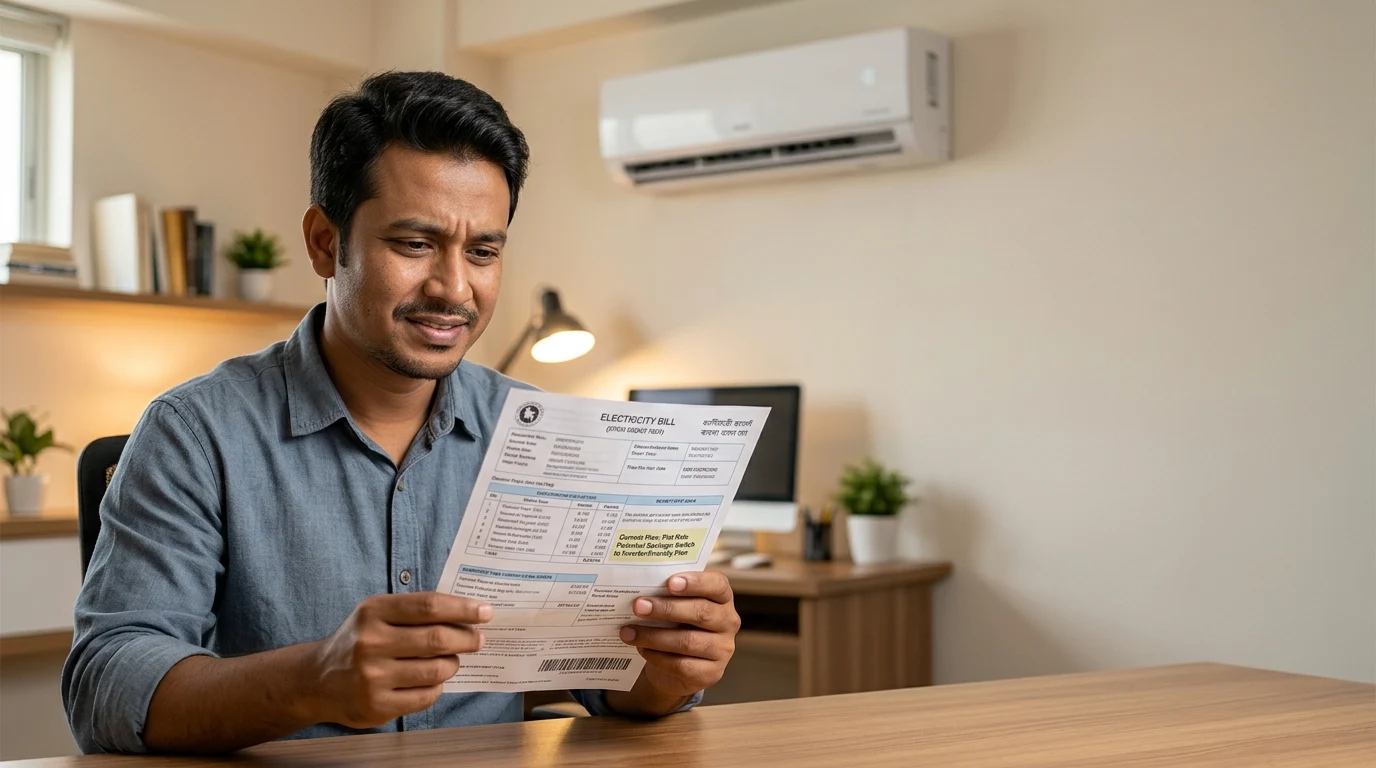
Running an air conditioner during hot, humid Bangladeshi summers often leads to stressful electricity bills. As temperature spikes hit urban hubs like Dhaka, Chittagong, and Cumilla, households frequently see their monthly utility costs double or triple.
Learning how to reduce AC electricity bill in Bangladesh comes down to smart operational habits, routine maintenance, and using energy-efficient technology. Following a few practical adjustments can help cut power consumption significantly without sacrificing indoor comfort.
This complete guide details ten actionable ways to lower monthly power bills, compares real operational costs, and explains when upgrading to a modern inverter unit makes long-term financial sense.
What Is the Average Monthly Cost of Running an AC in Bangladesh?
Running a standard 1.5 ton AC for 8 hours daily in Bangladesh costs between ৳1,600 and ৳3,800 per month on electricity bills, depending heavily on compressor efficiency and room conditions.
| AVERAGE MONTHLY AC ELECTRICITY COSTS (8 HRS/DAY) | ||
| AC Type | Daily Power Consumption | Monthly Cost Range |
| 1.5 Ton Non-Inverter | ~12 – 14 kWh (Units) | ৳3,200 – ৳3,800 |
| 1.5 Ton Inverter | ~6 – 7 kWh (Units) | ৳1,600 – ৳2,000 |
| ESTIMATED MONTHLY SAVINGS WITH INVERTER | ৳1,200 – ৳1,800 / mo | |
Bangladesh Power Development Board (BPDB) uses a slab-based tariff system for residential meters. Higher overall electricity consumption pushes households into elevated pricing brackets (৳8.50 to ৳12.00 per unit). Because fixed-speed non-inverter compressors draw high starting currents repeatedly, they quickly push home energy consumption into these costly higher tariff tiers.
Non-Inverter vs. Inverter AC: Real Numbers Behind the Bill Difference
The core reason non-inverter units draw more electricity lies in how their compressors operate. Non-inverter compressors run at 100% capacity until the room reaches the set temperature, turn completely off, and then restart at maximum power when the room warms up.
In contrast, an inverter compressor adjusts its motor speed dynamically. Once room cooling finishes, the motor slows down to maintain a stable climate using minimal electrical current.
| INVERTER vs. NON-INVERTER POWER CYCLE |
| NON-INVERTER: ON (100% Power) –> OFF (0%) –> ON (100% Power) |
| (Causes heavy current surges and frequent temperature fluctuations) |
| INVERTER : HIGH (Initial) –> LOW (Variable 20%-50% Power) |
| (Maintains steady room climate with continuous low energy draw) |
In a typical Dhaka home running an AC 8 hours every night:
- Non-Inverter AC (1.5 Ton): Consumes roughly 12 to 14 units per day, totaling ~390 units per month. At average BPDB rates, this equals ৳3,200 to ৳3,800 monthly.
- Inverter AC (1.5 Ton): Consumes roughly 6 to 7 units per day, totaling ~200 units per month. This reduces the bill to ৳1,600 to ৳2,000 monthly.
Over a 6-month summer season, operating an inverter model saves between ৳7,200 and ৳10,800. For a detailed technical breakdown of compressor mechanics, refer to our guide on Inverter vs Non-Inverter AC Bangladesh.
How Does Buying the Wrong Ton Capacity Increase Power Bills?
Installing an undersized or oversized air conditioner directly increases monthly power consumption. An incorrect cooling tonnage forces the compressor to work inefficiently, leading to higher energy bills and accelerated mechanical wear.
| TONNAGE MISMATCH IMPACT ON POWER BILLS |
| UNDERSIZED AC (e.g., 1.0 Ton in 200 sq. ft.): |
| –> Runs at 100% continuously | Never cools room | High bill |
| OVERSIZED AC (e.g., 2.0 Ton in 100 sq. ft.): |
| –> Short-cycles continuously | Poor dehumidification | High bill |
- Undersized ACs: If you place a 1.0 ton AC in a 200 sq. ft. room, the unit will run at maximum power continuously without ever reaching the target temperature.
- Oversized ACs: A 2.0 ton unit in a small 100 sq. ft. bedroom cools the space too quickly and shuts off before removing humidity, causing frequent short-cycling spikes.
Matching cooling capacity (BTU/hr) to room size ensures optimal efficiency:
| Room Size (Sq. Ft.) | Ceiling Height | Recommended Capacity |
| Under 120 sq. ft. | 10 ft. | 1.0 Ton (12,000 BTU) |
| 120 – 180 sq. ft. | 10 ft. | 1.5 Ton (18,000 BTU) |
| 180 – 240 sq. ft. | 10 ft. | 2.0 Ton (24,000 BTU) |
Before purchasing a new unit, use our online BTU Calculator to enter your exact room dimensions, ceiling height, and window exposure.
What Temperature Setting Saves the Most Electricity? (The 24°C Rule)
Setting your air conditioner to 24°C to 26°C provides the best balance between energy efficiency and cooling comfort.
| THE 24°C EFFICIENCY RULE |
| Setting Temperature to 18°C: |
| [x] Compels compressor to run continuously at peak draw |
| [x] Increases electricity consumption by 30% to 36% |
| Setting Temperature to 24°C – 26°C: |
| [✔] Allows inverter compressor to enter low-power maintenance mode |
| [✔] Saves 6% energy per degree increment |
Many users lower their thermostat setting to 18°C expecting faster room cooling. However, an air conditioner blows air out at the same temperature regardless of thermostat setting—lowering the setpoint simply forces the compressor to run longer at peak power.
According to energy efficiency studies, every 1°C increase in set temperature saves roughly 6% on electricity usage. Raising your setting from 18°C to 24°C reduces power draw by up to 36% while maintaining a healthy, comfortable indoor climate.
How Much Power Does a Dirty AC Filter Waste?
A clogged air filter restricts airflow, forcing the indoor blower fan and outdoor compressor to draw 10% to 15% more power to circulate air through the system.
| AIR FILTER CLEANING IMPACT |
| Clogged Filter : Restricted airflow –> Higher fan load –> +15% bill |
| Cleaned Filter : Free airflow –> Fast heat exchange –> Normal |
During dry Bangladeshi months, high dust levels in cities like Dhaka rapidly block mesh filters. Cleaning washable filters every 2 to 3 weeks restores proper airflow and protects cooling performance.
For step-by-step cleaning guidance and maintenance schedules, read our guide on AC Maintenance Tips Bangladesh.
How Should You Run Your AC at Night to Save Money?
Using specialized nighttime settings reduces power draw while keeping the room cool while you sleep.
| NIGHTTIME ENERGY SAVING STRATEGY |
| Enable Sleep Mode –> Automatically raises temp 1°C every 2 hrs |
| Combine with Fan –> Distributes cool air evenly on low speeds |
| Use Timer Off –> Programs unit to shut off at 4 AM or 5 AM |
- Activate Sleep Mode: Modern units automatically raise set temperatures by 1°C every two hours overnight. This offsets normal drop in human body metabolic rate during deep sleep while reducing compressor load.
- Combine with a Ceiling Fan: Running a ceiling fan on low speed alongside your AC distributes cool air evenly, allowing you to set the thermostat higher without feeling warm.
- Set Off-Timers: Program the unit to turn off at 4:00 AM or 5:00 AM. Bedrooms usually remain cool until wake-up time, saving 2 to 3 hours of power daily.
How Fast Does an Inverter AC Pay for Itself? (ROI Calculator)
Replacing an older non-inverter model with a modern inverter AC usually recovers its cost through bill savings within 24 to 30 months.
| INVERTER AC PAYBACK TIMELINE | |
| Upfront Price Difference (Inverter vs Non-Inverter): | ~৳15,000 |
| Average Monthly Electricity Bill Savings: | ~৳1,500 |
| Summer Usage Season: | 6 Months/Year |
| TOTAL RECOVERY TIME: | 2 Seasons |
Financial Break-Even Analysis
- Initial Price Difference: A 1.5 ton inverter AC costs around ৳12,000 to ৳15,000 more upfront than a basic non-inverter unit.
- Monthly Savings: Average monthly bill reduction equals ~৳1,500.
- Seasonal Savings (6 Months): ৳1,500 x 6 = ৳9,000 saved per year.
- Payback Period: Within two summer seasons, savings fully cover the initial price premium. Over a standard 10-year lifespan, total energy bill savings far exceed the original purchase cost.
Brands like Walton, Gree, and Haier offer competitive entry-level options. Elite and Midea focus on heavy-duty tropical compressors with extra anti-corrosive protection designed specifically for long-term power savings in Bangladeshi climates.
As Bangladesh’s local manufacturer of Elite ACs and authorized Master Distributor of Midea ACs since 2003, Elite Midea integrates built-in voltage protection and high-ambient cooling efficiency into every unit.
10 Quick Rules to Reduce Your AC Electricity Bill
| 10 QUICK RULES FOR AC ELECTRICITY SAVINGS |
| 1. Set temperature between 24°C and 26°C |
| 2. Clean mesh air filters every 15 to 20 days |
| 3. Seal window gaps, door bottoms, and wall penetrations |
| 4. Close heavy curtains to block direct midday sunlight |
| 5. Run a ceiling fan on low speed alongside the AC |
| 6. Use “Sleep Mode” for overnight cooling |
| 7. Turn off heat-generating electronics inside the room |
| 8. Schedule professional condenser wash before peak summer |
| 9. Match cooling capacity using a proper BTU Calculator |
| 10. Upgrade older fixed-speed units to modern R32 Inverter ACs |
Frequently Asked Questions (FAQ)
Does running a ceiling fan with an AC increase the power bill?
No, running a ceiling fan on low speed along with an AC actually reduces your overall power bill. The fan circulates cool air throughout the room evenly, allowing you to set the AC thermostat 2°C higher without losing comfort.
Is dry mode better for saving power than cool mode?
Dry mode saves electricity during rainy, humid monsoon days by removing moisture with low compressor load. However, during peak summer heat waves (April to June), cool mode is necessary to bring down room temperatures effectively.
How often should an AC be professionally serviced in Bangladesh?
An AC should receive full professional servicing at least twice a year in Bangladesh—once before summer heat hits (March) and once after the monsoon season (October). Servicing keeps condenser coils clean and maintains optimal refrigerant levels.
Does a stabilizer draw extra electricity?
Older analog voltage stabilizers consume extra power and generate heat. Modern Elite and Midea inverter ACs feature wide-voltage operation (150V–260V), eliminating the need for an external stabilizer in most urban areas.
Lowering your monthly AC electricity bill relies on a combination of smart habits and using efficient equipment. Keeping set temperatures around 24°C, cleaning filters bi-weekly, sealing room air leaks, and selecting the right cooling capacity keep power bills manageable throughout summer.
If your current air conditioner is over 6 years old, upgrading to an energy-saving inverter model offers long-term comfort and lowers monthly expenses.
Find the right cooling capacity using our BTU Calculator, or explore efficient models on our Elite Residential AC line and Midea Residential AC line.